Custom websites that capture the lead.
Built around your work, with the lead capture to match your trade — photo uploads so a customer can show you the job, an instant estimator that gives them a real range, or a quote form that asks exactly what you need to price it.
Your website is a dead end. That's what's costing you work.
Picture how this actually goes. Somebody needs a patio, a re-pipe, a dock. They ask around, get a name or two, then open their phone and search. Now they have three or four tabs open and an afternoon to decide.
They cannot inspect anyone's work. They cannot check anyone's references. They are not qualified to judge a base depth or a flashing detail even if they could see one. So they decide on what they can see: who looks established, who answers first, and who is cheapest.
Two of those three have nothing to do with whether you're good at the work. And if the only thing a customer can compare is price, you are going to lose to whoever is willing to earn less than you.
A dead end takes one of three shapes.
Every contractor we talk to is in one of these. None of them are a judgement — you have been busy doing the work.
No site at all
You exist on word of mouth and a truck door. That works until the person who would have recommended you is out of the country, or the customer is new to the area, or they want to check you out before they call. Then you are not in the running — not beaten, just absent.
A site from 2014
Built once by someone you can no longer reach. The photos are from a job you would not put your name on now, the phone number might be the old one, and it looks broken on a phone. It is worse than nothing, because it is evidence — and the evidence says you stopped caring a decade ago.
A Facebook page doing all the work
Your best job is buried under a post about being shut on Friday. Nobody can find what you charge, what areas you cover, or how to send you a photo of the thing that is broken. And you do not own any of it.
The expensive part isn't the jobs you lose. It's the ones you never hear about.
A lost bid at least tells you it happened. A dead-end website fails silently — somebody looked you up, found nothing worth reading, and called the next name on the list. You never get an email about that. You just have a quieter month and no idea why.
Which is why “we get all our work from referrals” is usually true and still a problem. It means the only people hiring you are the ones who were told to. Everybody else who went looking couldn't find a reason to pick you.
What a real site changes, specifically.
Not “a professional online presence”. Three concrete shifts in what a customer can do before they ever speak to you.
- They can't see your workThey can see the job you're proudest of, shot properly
Not a phone snap taken into the sun on the way to the truck. The finished thing, lit well, from the angle that shows what was hard about it. A homeowner cannot judge a mitre joint or a compacted base — but they can absolutely tell the difference between a photograph taken with care and one taken in a hurry, and they read that as how you work.
- They can't tell you apart from three other quotesThey can see how you think about the job
The pages that convert are the ones that explain something: why a deeper base matters in Lowcountry sand, why the permit takes longer than the build, what a cheaper bid leaves out. You are not selling a service. You are demonstrating that you know things the other two quotes do not.
- They have to call to find out anythingThey can get an answer at 9pm without speaking to anyone
Most people would rather not phone a stranger to ask what something costs. A price range, an estimator, a form that takes photos of the actual job — these do not replace the conversation. They start it, with someone who already trusts you enough to describe their problem.
The craftsmanship is the proof. It just has to be visible.
This is the belief the whole company runs on, and it comes from our sibling agency, which spends its days on job sites with a camera: the contractor is the hero, the crew is the story, and the craftsmanship is the proof.
The problem is that craftsmanship is invisible online. A tradesman who compacts the base properly and one who does not produce photographs that look identical on a phone. So the careful one gets no credit for being careful, and ends up competing on price against someone whose work will fail in three years.
A good site does not make you better at your job. It makes you legible — so the thing you are already good at is the reason you get hired, instead of the thing nobody could see.
Not sure whether yours is one of them?
Send us the address. We'll go through it the way one of your customers would and tell you what it's costing you — free, and you don't have to hire us to use any of it.
We open it on a phone
Which is where nearly all of your customers will see it, and almost never where it was built or checked.
We tell you what's stopping the call
Not a score out of a hundred from some tool. The actual reasons somebody lands on your site and doesn't ring you.
You get it in writing
No call to sit through, no obligation. If you want to fix it yourself with what we send, that's a fine outcome.
Everything, running, from day one.
A site built for a phone first
Most of your customers will find you on a phone, standing somewhere with one bar. That's the version we design first, not an afterthought squeezed down from a desktop layout.
Lead capture built for your trade
Photo uploads if seeing the job is what you need. An instant estimator if a number up front is what stops people calling around. A plain quote form asking exactly the questions you'd ask on the phone. Whatever gets you what you need to price the work.
A gallery of your actual work
Your jobs, your crew, your trucks. No stock photos of someone else's job site.
Pages for the areas you serve
A page for each town or area you work in, so you turn up when someone searches for your trade near them.
Hosting, SSL and updates
It stays up, it stays secure, and it stays current. Nothing to renew, nothing to remember.
Google Business Profile set up
The listing that shows on the right of a Google search and on Maps — claimed, filled in, and pointed at your site.
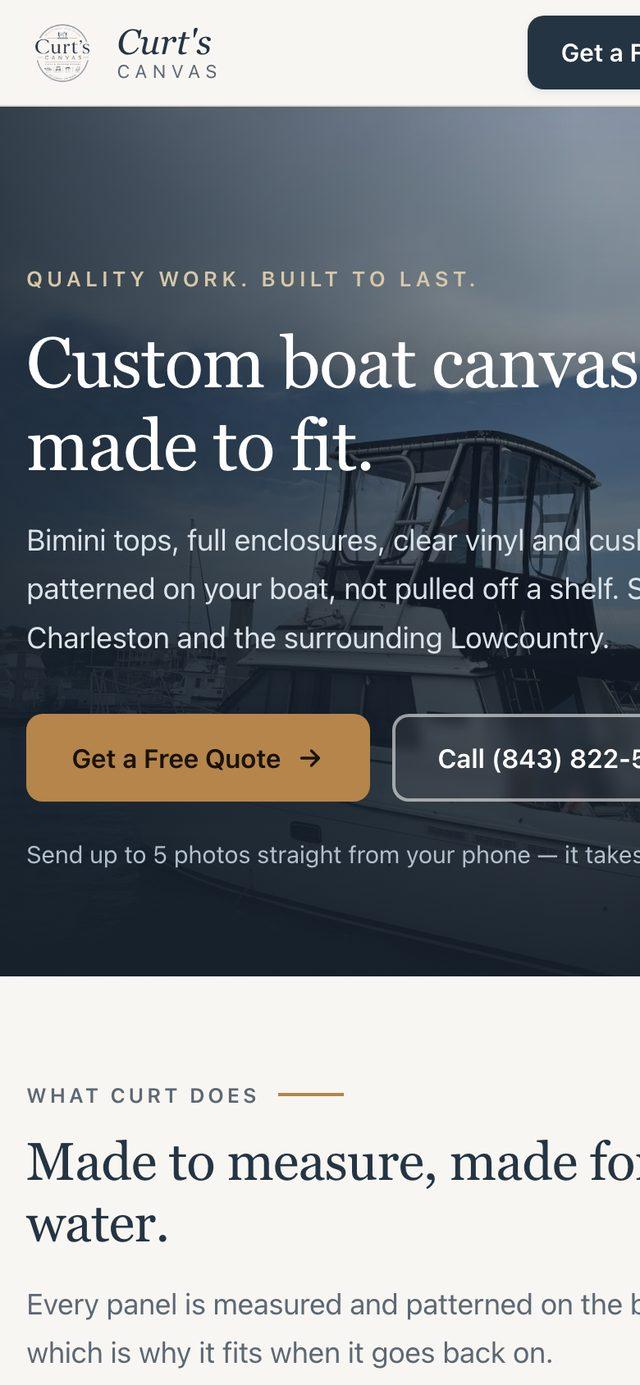
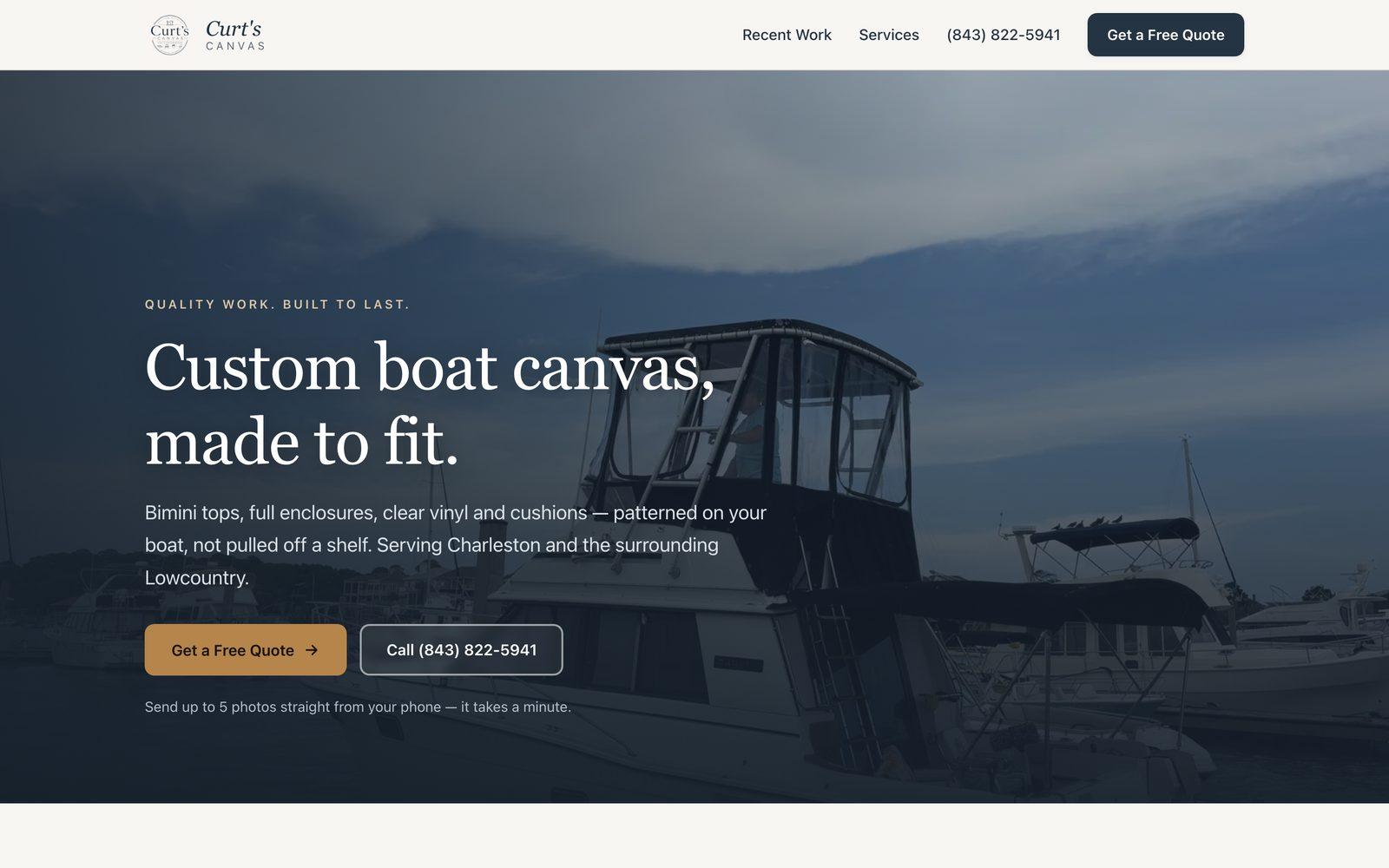
Curt's Canvas, Charleston.
A marine canvas shop. Bimini tops, enclosures, cushions. Here's what got built and what it does for him now.
The problem
Quoting canvas work means seeing the boat. Every enquiry turned into a phone call, then a drive to the dock, before Curt knew whether it was even a job worth taking.
What got built
A mobile-first site with the work up front, and a quote form that takes up to five photos straight from a phone, compressed automatically so they send from the dock on patchy signal. Boat make and model, where it's kept, what needs doing.
What it does now
A customer standing at their boat sends photos in about a minute. Curt looks at them and comes back with a real price — no drive, no site visit to find out it wasn't worth the trip. In his own words on the site: “Send up to 5 photos straight from your phone — it takes a minute.”
Curt has told us he's happy with how the site turned out, and with the photo-based quote form in particular.
Relayed by us, not a direct quote — we'll put his own words here when he sends them.
The same system, different trades.
Mocks we've built to show what's possible. Each one is labelled for what it is — none of these are client engagements.
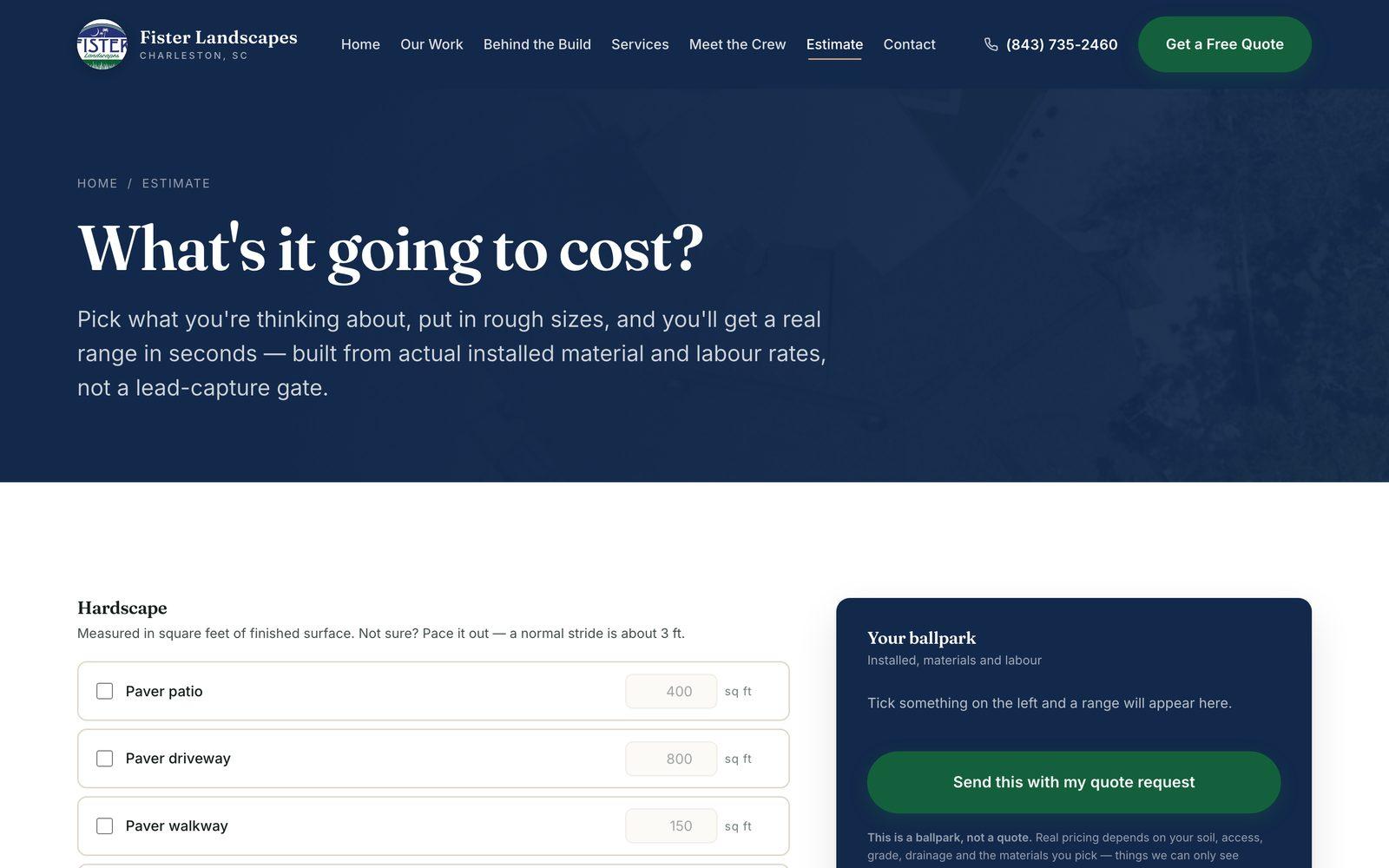
Fister Landscapes
Tick a paver patio at 400 sq ft and it returns $6,400–$9,200, itemised, in about a second — before asking for an email. In its own words: built from real installed rates, “not a lead-capture gate”.
A demo, not a client — hosted on a preview URL.
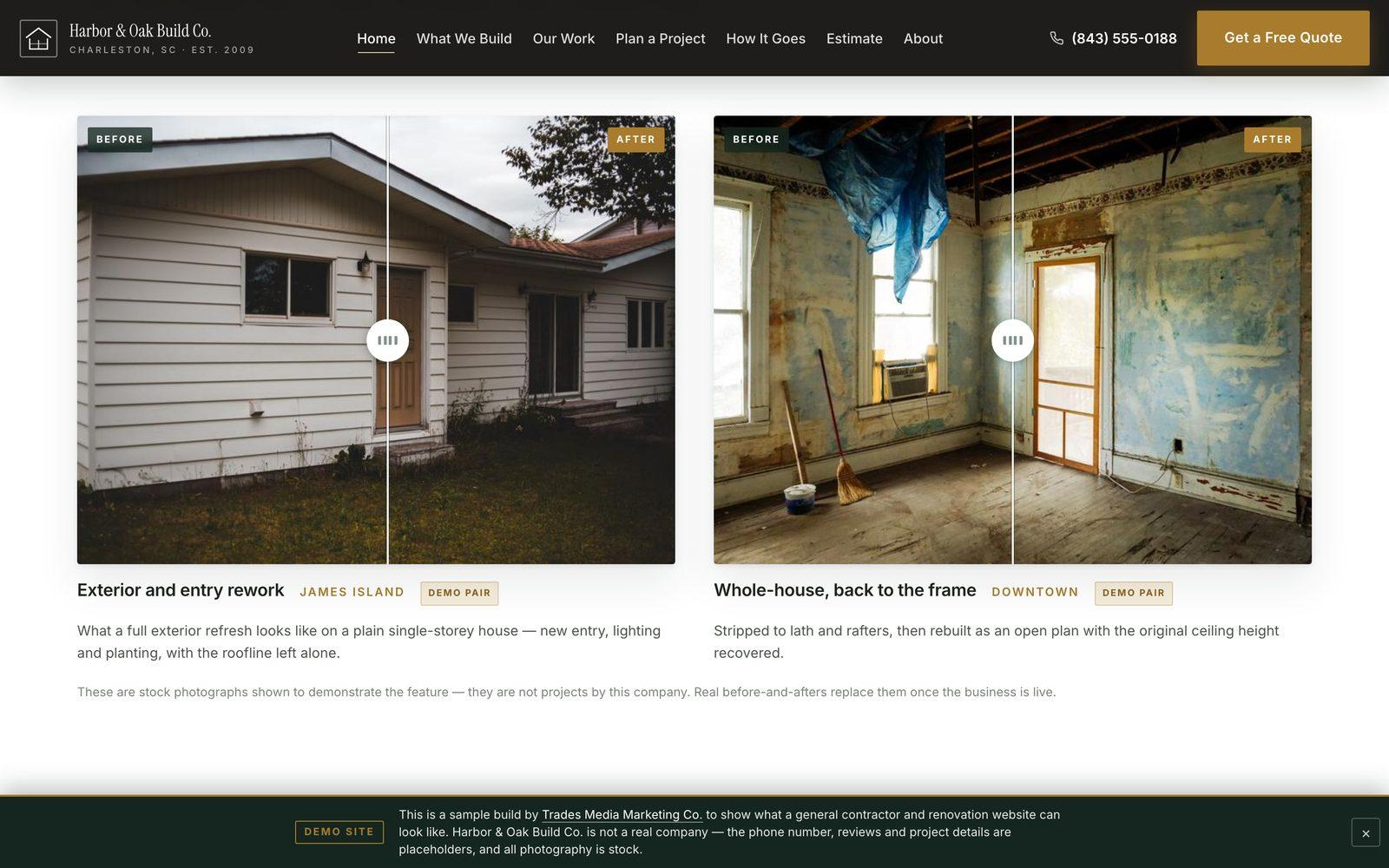
Harbor & Oak Build Co.
A drag-the-handle before-and-after, because renovation work is the one trade where the photo is the argument. There's an estimator too — 19 questions to a $65,000–$125,000 range.
A concept, not a client — the site carries its own demo banner, and the photography is stock.
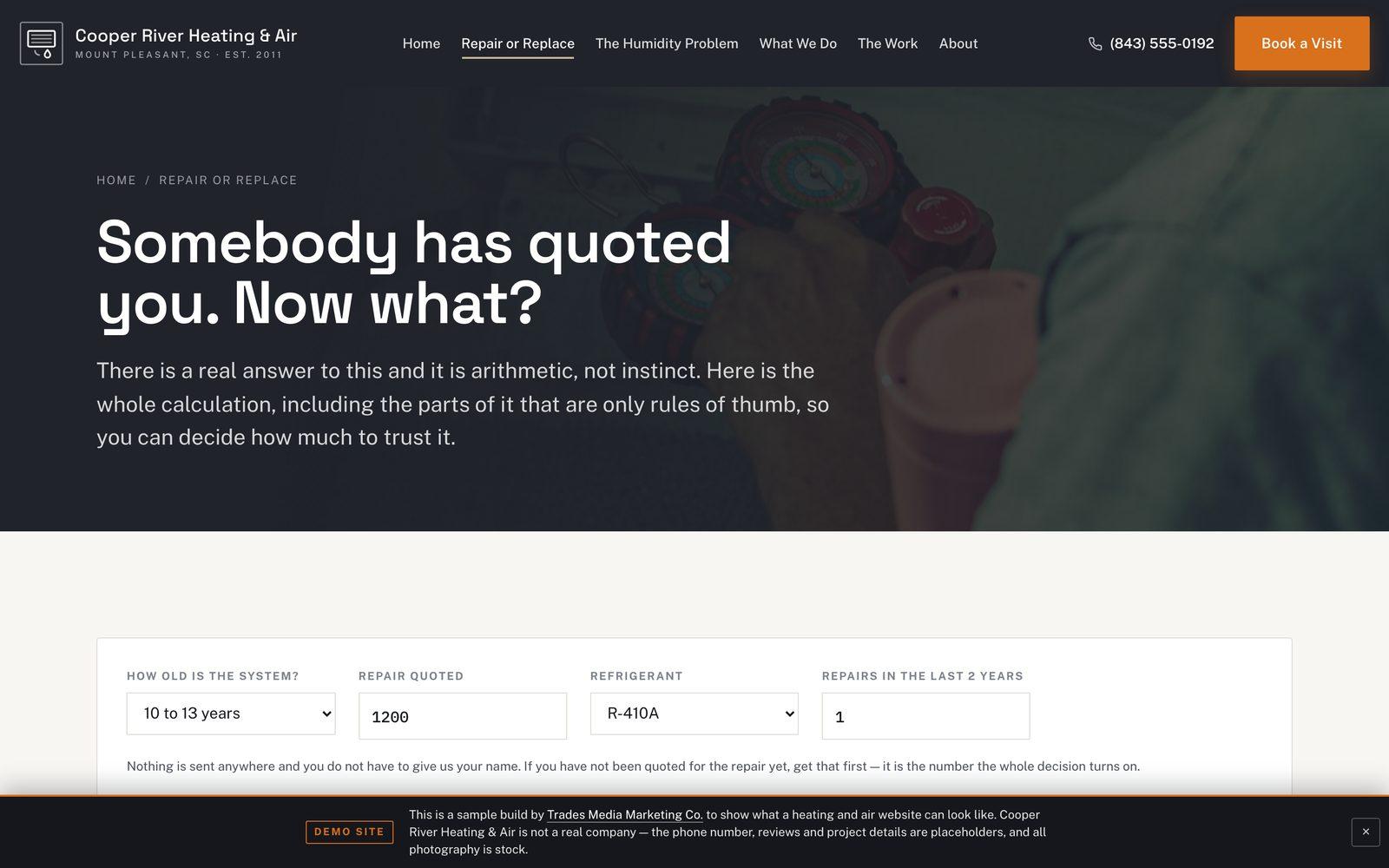
Cooper River Heating & Air
“Somebody has quoted you. Now what?” Repair-or-replace as arithmetic instead of a recommendation, showing the whole calculation — and saying which parts are only rules of thumb, so you can decide how much to trust it.
A concept, not a client — the site carries its own demo banner, and the photography is stock.
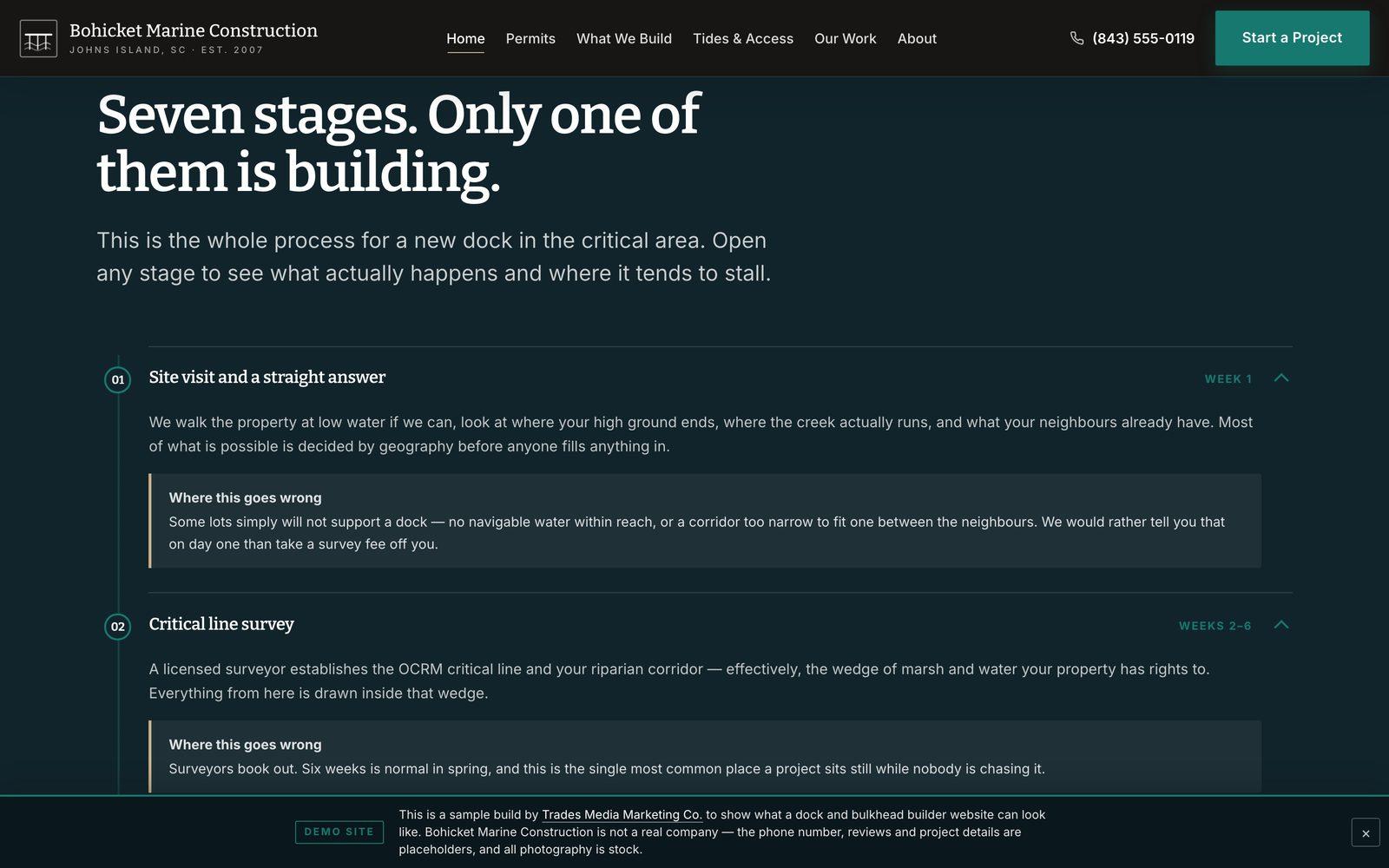
Bohicket Marine Construction
“The permit takes longer than the dock.” Seven stages, only one of which is building, and each one says where it tends to stall — including that some lots will not support a dock at all, which they would rather tell you on day one than take a survey fee for.
A concept, not a client — the site carries its own demo banner, and the photography is stock.
And 7 more, each leading on something different:
- Lowcountry Stucco Co.Stucco & plaster
- Wade Coker PlumbingPlumbing — solo operator
- Brightwork Marine DetailingBoat detailing
- Shoalwater Marine ServiceMobile marine mechanic
- Legare Roofing Co.Roofing
- Wappoo Exterior Co.Roofing & siding
- Ashby Home RepairHandyman — one-man shop
You own your domain and your content.
Registered in your name, on your account. If you ever want to leave, you take the site, the photos and the copy with you and we release the domain — no exit fee, no hostage period. Building your business on something somebody else can switch off is a bad deal, and we're not going to offer you one.
Four steps, and most of them aren't yours.
The whole thing costs you about half an hour of attention.
- 1
You send us what you've got
Photos, your logo if you have one, and a rough idea of what you do. If you don't have photos, we'll tell you what to shoot on your phone.
About 20 minutes of your time - 2
We build it
You don't write anything. We write the copy from what you told us and what your work shows.
Roughly 10 business days - 3
You look at it and tell us what's wrong
A real link, not a mockup. You send changes in plain language — "that photo's the wrong job" is a perfectly good note.
One round included, usually a day or two - 4
It goes live
We point your domain at it, set up the Google listing, and you start getting quote requests in your inbox and your portal.
Same day once you sign off
One setup fee, then monthly.
No percentage of your revenue, no per-lead fee, no charge for a good month.
| To build itOne time, paid when it goes live | $1,500 |
|---|---|
| To host and manage itMonthly, cancel with 30 days' notice | $250/mo |
What monthly covers
- Hosting, SSL and the domain renewal
- Two content updates a month — new photos, prices, hours, a page for a new service area
- We reply within two business days
- Security patches and backups
- Your portal, so you can see quote requests as they come in
What it doesn't
- Anything past those two in a month — billed at $95 an hour, quoted before we start
- New sections or a rebuild, quoted separately
- Photography and video — that's Lowcountry Construction Media
- Running your ads
Nothing is charged until you've seen the terms in writing and agreed to them. Can't swing that yet? Keep reading.
Don't have the money for a site and a shoot yet? Talk to us anyway.
$1,500 for a website and $475 for a basic shoot is real money when you're new and it's you and a truck. If you're trying to do good work and build something real, we'd be happy to help — tell us where you're at and we'll work something out.
Tell us where you're at
What you do, how long you've been at it, what you've got — photos on your phone, a site from 2019, nothing yet. Honest is fine. Honest is the point.
We work out a deal that fits
What that looks like depends on you and the work. It gets settled on a phone call, not in a form, and not with a price list.
We help you out now. You help us out later.
When the work's coming in. That's the whole deal.
No decent photos of your work? That's fixable.
The most common thing standing between a contractor and a site worth showing anyone is a camera roll of blurry phone pictures. Our sibling agency shoots the real thing.
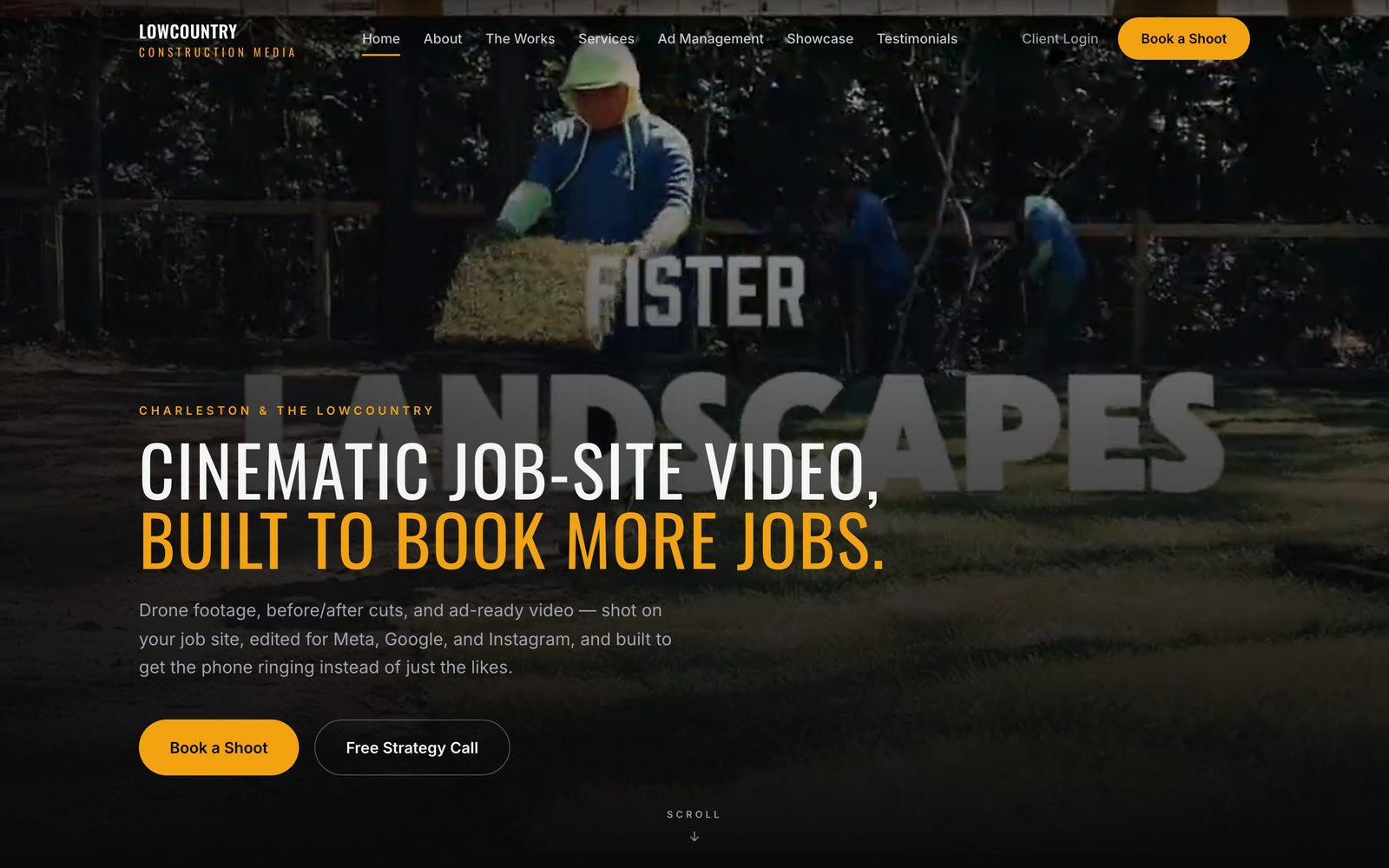
Cinematic job-site video, built to book more jobs.
Drone and ground footage shot on your job site, cut for Meta, Google and Instagram — and shot so it can be used everywhere else too: your website, your proposals, your truck wraps. Charleston and the surrounding Lowcountry.
- Drone and aerial
- Ground video
- Before-and-after cuts
- Photography
- Jobsite documentation
- Owner testimonials
Why there are two companies
Lowcountry Construction Media is the production agency — cameras, drones, editors. Trades Media Marketing Co. builds the platform their work runs on. Same founder, same clients, two different jobs — and the pair we intend to open in every booming town. This is the first.
It also means TMOS was built by people who actually shoot this stuff for a living, on the problems that came up doing it — rather than guessed at from the outside.
You can hire either one without the other. Plenty of clients take the site and shoot their own photos, and plenty book a shoot without a site.
The questions we get every time.
Tell us about your business.
Takes a couple of minutes. We'll come back within one business day with what it would take and what it would cost.